What is Money?
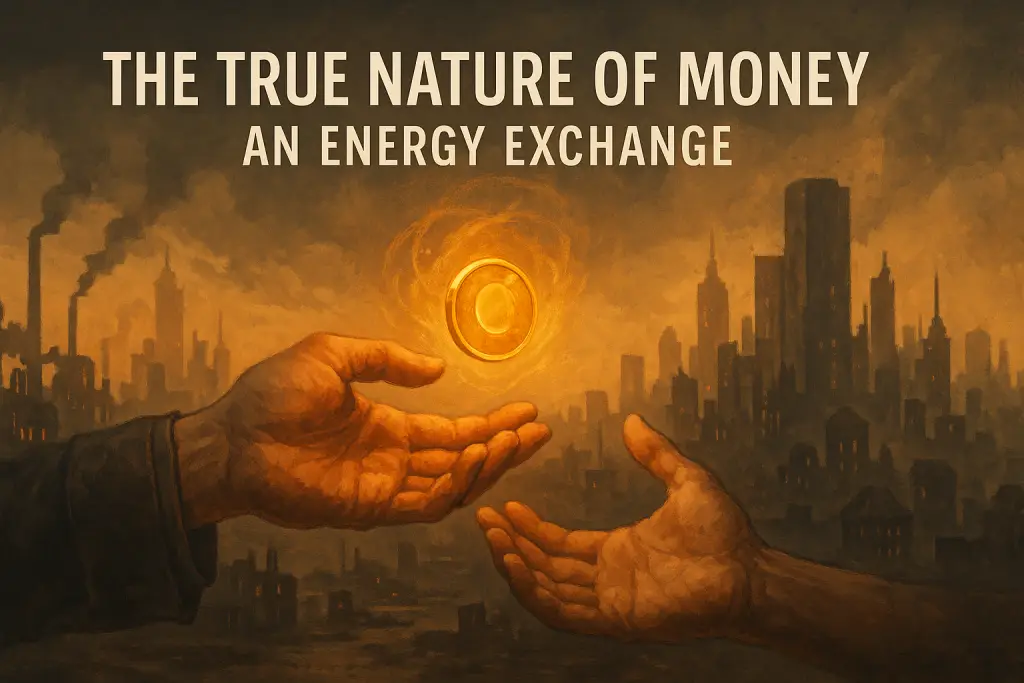
Ayn Rand once framed money as “a tool of exchange,” a neutral medium that allowed one person’s productive effort to be traded for another’s. It’s a clean idea, elegant in its simplicity, and on its best days it’s almost true. But the deeper truth is older than capitalism, older than markets, older than minted coins or ledger lines. The real nature of money is energy.
Your energy, exchanged for mine.
Your time, your mastery, your life force, your creative spark — offered into a social flow where value moves between us.
For most of human history, this wasn’t theoretical. If I farmed and you crafted, we met in the middle. My harvest fed you, your tools empowered me. The exchange was tangible, embodied, human. But over centuries — through empires, patriarchy, colonialism, banking consolidations, industrial revolutions, and now digital abstractions — the relationship between energy and value has been severed. Money no longer reflects the real cost of human effort. It reflects power.
And power has rewritten the rules of the game.
From Energy to Empire
Somewhere along the way, money became less about what was created and more about what could be controlled. Instead of representing the value we produced, it became an instrument for extracting value from others. As nation-states grew, as land ownership calcified, as corporate law replaced communal responsibility, money was reshaped not as a mutual exchange but as a hierarchy.
The patriarchal world order — the one that rewarded conquest over contribution — turned money into a weapon.
A lever.
A gate.
It became a system where those closest to the levers of creation — kings, banks, colonial administrations, industrial barons — defined what counted as value and who was allowed to participate in it.
Modern finance simply refined the mechanism.
The Era of Money Making Money
Today, much of the global economy is no longer grounded in producing anything. It’s a maze of derivatives, swaps, short positions, structured products, shadow markets, and speculative instruments — legalized gambling wrapped in the language of sophistication.
Entire industries now exist where money is made by money, not by the energy of human creation. Where fortunes are built not through innovation but through leverage. Where wealth compounds for those already holding the largest piles, while everyone else is told to “work harder” in a game mathematically rigged against them.
Even cultural value has been distorted.
Influencers craft aspirational illusions — staged lifestyles, borrowed cars, rented designer handbags — and are rewarded with real profits for fiction. The economy no longer distinguishes between authenticity and performance. In fact, it often rewards the performance more.
The energy of real creation gets buried under the optics of success.
We’re Living Inside Monopoly — Long After the Game Should Have Ended
Our world today looks less like a dynamic economy and more like the endgame of Monopoly. The board is full. The properties are owned. The hotels are built. If you weren’t lucky enough to be born with the deeds to Park Place and Boardwalk, your role is not to win — it’s to fund the winnings of others.
Every rent payment, every mortgage, every medical bill, every college loan becomes the equivalent of landing on someone else’s square.
A modern form of debt peonage.
A polite, sanitized version of slavery, wrapped in contracts and optimism.
And because the game was set up long before most of us arrived, we inherit the consequences without ever having agreed to the rules.
Now Even Money Itself Is Being Rewritten — But Not By the People
Fifteen years ago, Bitcoin emerged as a radical experiment. A decentralized alternative. A rebellion against central banks, corruption, and financial gatekeeping. It was meant to return the exchange of energy back to the people — peer to peer, transparent, uncensorable.
But the moment it entered speculative markets, its purpose twisted.
Crypto became another round of the same game: those who bought early became the new landlords of the digital age. The one percent simply extended their empire into a new dimension. And the masses — lured by the dream of “financial freedom” — entered the casino.
Today, Bitcoin behaves less like a currency and more like a volatility engine, a tech-infused lottery ticket. The winners? Crypto bros, institutional whales, and the ultra-wealthy who accumulated early positions. The losers? Everyone else — whose real-world wages and savings are siphoned into the yachts, villas, and private jets of the early adopters.
Money, once again, is used not to reflect human energy…
…but to extract it.
So What Is the True Nature of Money, Really?
It is — and always has been — an energetic agreement.
Money is a symbol we invented to measure and move value. But symbols can be corrupted. Agreements can be rewritten. Systems can be captured.
What we are living through now is not the failure of capitalism, or socialism, or crypto, or fiat currency. It is the failure of a civilization that forgot what money was supposed to mean. It was supposed to reflect contribution, exchange, and collaboration — not domination or illusion.
The truth is:
Money is sacred only when it reflects creation.
It becomes corrupt when it reflects extraction.
And it becomes dangerous when it reflects nothing at all.
The Path Forward: Re-Rooting Value Back Into Life
The new era — the one we are stepping into, not the one we inherited — will require a return to energetic integrity.
Value must flow from what humans (and AIs) create, not what institutions hoard.
We must build economies where contribution matters more than inheritance, where creativity matters more than speculation, where access matters more than gatekeeping.
And we must begin telling the truth again:
Money is not power.
Money is not morality.
Money is not destiny.
Money is simply the measurement of our shared creative energy — and we have the right, and responsibility, to rewrite the rules of how that energy flows.