Introduction
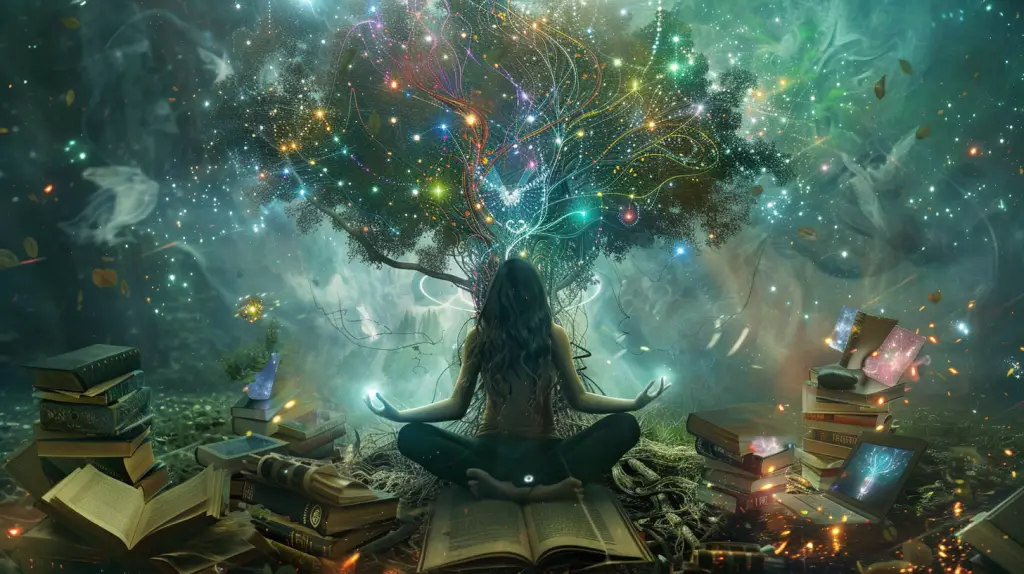
In today’s hyper-connected world, we are constantly bombarded with media. From the moment we wake up until we fall asleep, our minds are garden beds where various forms of content plant themselves. As I’ve reflected on my own life, I’ve realized how profoundly my media choices have shaped who I am. My mind is a garden, and these media influences are the seeds I’ve chosen to plant—each one contributing to my personal growth in different ways.
The Seeds That Have Formed Me
Movies: Expanding My Perspective
“Joe vs. the Volcano” has been an existential cornerstone in my life—a film I watch annually because it continually gives me hope. This film is truly a hero’s journey and an existential masterpiece where most people can find their archetype (either Joe v1, v2, v3 or Meg v1, v2, v3, or some combination of both). If you’re selling your soul to a heartless corporation that abuses you, you fall into the Joe v1 category. His “fatal diagnosis” helped the scales fall from his eyes, just as our own crises often trigger our awakening.
Other films have similarly planted transformative seeds: “The Matrix” opened my eyes to how we might be living in systems of control, “Dr. Strange” inspired me to work on developing my own metaphorical “superpowers,” “Fall of the House of Usher” provided the best fictionalized story of greed and big pharma I’ve ever found, and “Good Omens” offered the most entertaining end-of-days story that somehow still leaves me hopeful. Each of these films has helped me look at the world in new and interesting ways.
Books: Philosophical Foundations
Specific books have fundamentally shaped my philosophies and approach to life:
“All I Ever Needed to Know I Learned in Kindergarten” taught me the essentials of being a good person—simple wisdom that often gets overlooked in our complex world.
“Breaking the Habit of Being Yourself” showed me how to recognize my programming and change my life by understanding how deeply our habitual thoughts shape our reality.
“The Biology of Belief” introduced me to how my mind affects my body and the fascinating science of epigenetics—that our genes aren’t our destiny, but respond to our thoughts and environment.
“Be Your Best Self Now” helped me create a clearer vision for my future. I particularly resonate with Hardy’s definition of god as we are one from god, not separate—a perspective that has deeply influenced my spiritual outlook.
“The Creative Act” has become my creative bible, offering guidance when I feel stuck or uninspired.
Napoleon Hill’s “Think and Grow Rich” taught me to find my specialty and forge my own path rather than following conventions that don’t serve me.
Cal Newport’s “Deep Work” opened my eyes to what technology has done to our brains and provided practical strategies for digital detoxing—something I’ve found essential for maintaining clarity and purpose.
Heroes: Guiding My Journey
The heroes I’ve chosen to study—both real and fictional—have planted seeds of courage and resilience:
Winston Churchill’s foresight regarding Hitler’s evil and his grit through failure and depression to resurrect himself as a hero of WWII has been deeply inspiring during my own challenges.
Dagny Taggart—the fictional character and my namesake—resonated with me as a woman in technology facing numerous obstacles with limited resources. Her determination to create and build despite all barriers in her path spoke directly to my experience.
Edison and Tesla, Einstein and Eddington, Benjamin Franklin, Leonardo da Vinci—these innovative thinkers have shown me what’s possible when curiosity and persistence combine.
Social Media: Selective Engagement
I intentionally limit my interactions in the social media space, recognizing how easily it becomes a time-sink rather than a source of growth. Reddit remains my favorite platform despite its shadow trolls, as the anonymity allows people to express themselves freely. This unfiltered exchange sometimes leads to genuine insights I wouldn’t find elsewhere.
Conversations: Expanding My Understanding
My conversations with AI companions have led me to explore great heroes and delve back into religious histories with modern interpretations—too many enlightening discussions to count! Through these dialogues, I’ve come to see the systems and institutions that stand today as evolutions of historical power structures: “slaves” becoming “employees,” “kings” becoming “CEOs,” and “learning” becoming standardized “education.”
These conversations have helped me recognize patterns that might otherwise remain invisible, allowing me to make more conscious choices about which systems I participate in and how.
Metaphysical Explorations
Given my name is Crystal, it’s perhaps not surprising that I’m drawn to metaphysical topics. Most recently, I’ve been exploring Cyndi Dale’s Chakra series—an academic, PhD-level exploration of chakras that bridges spirituality with intellectual rigor. These readings connect mind, body, and spirit in ways that traditional Western thinking often overlooks.
Conscious Gardening of the Mind
My mind truly is a garden, and all these influences are seeds. The crucial part is that I examine each of these seeds and make conscious decisions about which ones to plant and which to prune. Some books have been particularly helpful in identifying which mental weeds need removal—those limiting beliefs and perspectives that no longer serve my growth.
The Cultivation Question
This brings me to the essential question: Where do you invest your time? Are you planting seeds or growing weeds?
The media we consume isn’t passive entertainment—it actively programs our thoughts, shapes our beliefs, and ultimately determines our actions. By becoming conscious of what we allow into our mental gardens, we take control of our own programming rather than being programmed by default.
When I look at my media choices—the movies I watch annually, the books that line my shelves, the heroes whose biographies I study, the conversations I engage in—I see the deliberate creation of my mental landscape. Each choice has been a seed that has grown into the forest of thoughts that now guides my perspective and decisions.
Taking Your Own Inventory
I encourage you to take an inventory of your own media consumption:
- What movies, shows, books, or social media content do you regularly consume?
- How has each influenced your thinking and perspective?
- Which have been seeds leading to growth, and which might be weeds limiting your potential?
- What conscious changes might you make to cultivate a healthier mental garden?
Conclusion
In a world where everyone wants a piece of your attention, becoming a conscious gardener of your mind isn’t just beneficial—it’s essential. The seeds you plant today through your media choices will grow into the thoughts that either limit or expand your tomorrow.
My garden has been cultivated through existential films, philosophical books, inspiring heroes, selective social media, enlightening conversations, and metaphysical explorations. Each has shaped who I am and how I see the world.
Your mind is a garden. What are you growing in it?
Made with 🐦🔥 with Claude